Why Torches Last Longer Than People
New fire torches aren’t pushed to their limit right away. You light them briefly, multiple times, let them go out, light them again. A protective layer forms. And ideally, you extinguish the torch before it burns out completely - to protect the material.
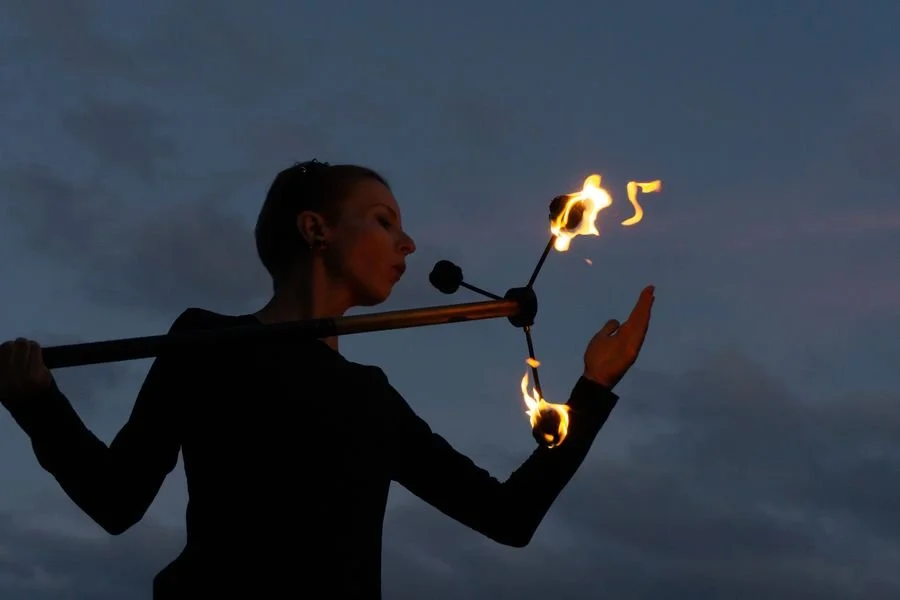
With people, we do the opposite.
We expect them to run at full capacity from day one. To keep going until there’s nothing left.
And when they collapse, they’re supposed to do it quietly - and feel ashamed for not being “resilient enough.”
Burnout Is Not Personal Failure
Let’s be honest: Talk of “burnout prevention” obscures the real problem. It suggests exhaustion is avoidable - if only you were mindful enough, did enough yoga, set the right boundaries.
But burnout doesn’t happen because individuals handle stress poorly.
Burnout happens in systems that systematically overload people - or underload them. Even the World Health Organization classifies burnout as resulting from “chronic workplace stress that has not been successfully managed” (WHO, 2019) - a workplace phenomenon, not a personal flaw.
Systems that replace meaning with mere productivity: as long as you deliver. Regardless of whether what you’re doing is actually needed. Regardless of whether it fulfills you. Systems that prioritize functioning over wellbeing.
And some people pay this price twice over.
Who’s Particularly At Risk (And Why That’s No Coincidence)
Some people carry higher risk - because their perception, nervous system, or personality structure collides with the systems they work in.
Neurodivergent people are at higher risk, because the world is rarely built for their nervous system - for autistic people, this even has its own name (more below).
Highly sensitive and neurotic people (in the psychological sense: with heightened emotional reactivity) pay the same price - they perceive more, process more deeply, and that costs energy that often nobody sees or values.
Justice sensitivity: When you constantly see systems failing - children being neglected, colleagues exploited, senseless rules causing harm – and you can’t ignore it, that costs energy. Every day. On top of your actual work.
Masking: The effort to appear “normal.” To hide sensory overload. To perform social codes that don’t feel intuitive. That’s work. Invisible, unpaid work.
Efficiency orientation meets inefficient structures: When your brain seeks logic and clarity, but the system is bureaucratic, contradictory, and meaningless - that’s not just frustrating. That’s exhausting.
This means: Some people don’t burn out because they work too much. They burn out because, in addition to their work, they have to do the work of existing in a system that wasn’t made for them.
Autistic Burnout vs. Regular Burnout
Autistic burnout is more than occupational burnout with an autism label. Researchers describe it as a state of exhaustion and distress that reaches every area of life - work, but also shopping, seeing friends, opening the mail (Raymaker et al., 2020). Typical signs:
chronic exhaustion that rest barely touches
loss of skills that used to work - speaking, organizing, everyday tasks
lower tolerance for sensory input: noise, light and crowds become overwhelming faster
What drives it? Autistic adults in the study named the sheer amount of everyday stress, too little time to recover, and expectations that outweighed their abilities - often without support, because the people around them didn’t understand what was happening.
Masking adds to the load: the constant effort of appearing “normal” costs energy, day after day.
Recovery usually means fewer demands, more rest and fewer situations that require masking
- and environments that make room for autistic nervous systems instead of expecting them to adapt.
Burnout and Boreout: Same Symptoms, Different Paths
Exhaustion doesn’t only come from too much. It also comes from too little - too little meaning, too little autonomy, too little significance.
Boreout and burnout can look strikingly similar: exhaustion, cynicism, emotional numbness.
The difference isn’t the outcome, but the path there.
Both are reactions to the same problem: work that separates you from what you actually care about.
What Actually Protects (And What Doesn’t)
Mindfulness apps and resilience training can support - but they don’t protect against burnout when the structures make you sick.
What actually protects is meaning. Psychological research shows this clearly: people who experience their work as meaningful, who have autonomy, who feel effective - they last longer. The strain simply hits them differently.
Meaning buffers stress. Meaninglessness amplifies it.
But meaning can’t be created individually when the structures are meaningless. No amount of positive mindset helps when the system systematically drains you.
What “Getting Back Up” Really Means
Getting back up after burnout doesn’t mean functioning like before.
It means recognizing which flames were never yours. Which expectations you fulfilled out of fear of rejection, not inner drive. Which systems you kept running because the alternative seemed worse.
It means recalibrating. Not “back to old strength,” but toward a wiser relationship with your own energy.
Work smarter, not harder sounds like self-optimization - but sometimes it’s simply: stop grinding yourself down for systems that were never made for you.
Humans Are Cyclical Systems
People aren’t machines. We’re dynamic, adaptive systems.
We flicker. We glow. We go out. We reignite.
That’s not a malfunction. That’s vitality.
Burnout prevention can’t mean never going out. It must mean creating structures where people can burn and refuel - without having to function at constant brightness.
This piece is part of my ongoing exploration of what it means to work in systems not built for your nervous system - and why changing them is a collective responsibility, not an individual one.
Want to follow that exploration? My newsletter brings psychology, neuroscience and a little magic to your inbox: Sign up here
And if you’re running on empty right now: that’s what therapy or mental support is for.
Elena Tinkloh (aka Tink) is a licensed psychotherapist in Germany, specializing in cognitive behavioral therapy, and a fire performer. She works at the intersection of neurodivergence, trauma, and systemic critique.